


SE-LE-NI-UM
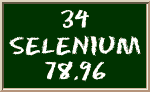
 Selenium is one of the more versatile elements of the periodic table. You can find it in many forms (allotropic forms) including reddish crystals and metallic gray. It was named after the moon when discovered in 1817 by the scientist Berzelius. While rare, selenium is normally found in minerals.
Of the lesser members in the sulfur family, selenium is the most abundant in nature, often found in copper and lead mining. Tellurium and polonium are other members in the same family (and found in the same column of the periodic table).
Where can you find selenium?

|
Mining When industry mines an area, many additional minerals are uncovered. If you were to visit a copper mine and looked through all of the minerals you would probably find good amounts of selenium. |

|
Trace Element Here's an interesting fact. Large amounts of selenium will act as a poison but you need trace amounts of this mineral to survive. You usually get selenium in your diet when you eat meat. |

|
Solar Cells This is probably one of the most well known uses for selenium. Selenium has photovoltaic properties. That term means that it can convert light into energy. It just makes sense that selenium is an important part of any equipment design to convert the Sun's energy into electricity. |

|
Glass Add a pinch of selenium and you can give your glass creation a red color. Trace amounts of many elements will change the color of glass. |

|
Photocopiers In the same way that selenium is handy in a solar cell, it is also an element used in photocopiers. That light energy can really make this element work hard. |

|
Power Converters AC power comes out of the wall. DC power comes from a battery. Sometimes you want one type of power converted into the other. That converter often has a little selenium inside to make the magic happen. |

 See the full list of chemistry topics at the site map!
©copyright 1997-2017 Andrew Rader Studios, All rights reserved.
Current Page: Chem4Kids.com | Elements | Selenium
** Andrew Rader Studios does not monitor or review the content available at external web sites. They are paid advertisements and neither partners nor recommended web sites. Also, we do not collect or ask for personally identifiable information on any of our sites. Privacy Policy/Terms & Conditions