

DNA Details
DNA stands for deoxyribonucleic acid. It is special, because it holds the code for every cell in your body. That's right. Every cell in your body uses DNA as an instruction manual. If you want to take away the importance of that statement, you can say that DNA is just a long spiral chain of nucleotides. But it's more. So much more.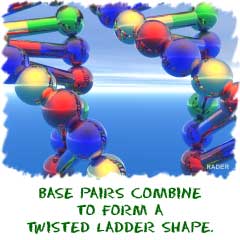 So, you get all of those nucleotides in two long chains that twist around each other. That twisting shape is called a double helix. The spiral ladder has the ability to wind and unwind so that the nucleic acid chain can duplicate itself. That duplication process, called replication, happens every time a cell divides.
DNA Down Time
When a cell is in its normal state, the DNA is not duplicating and it just looks like a blob of white strands. Scientists use the word chromatin to describe that DNA. Chromatin can be found in several levels of organization. It changes its overall structure (physically, not chemically) during different times of the cell's life. The nucleic acid chains usually sit around uncoiled as loose strands. When it is time for the cell to reproduce, they condense and wrap up very tightly. The tightly wound DNA is called a chromosome. Chromosomes look kind of like long, limp hot dogs. They are also found in pairs.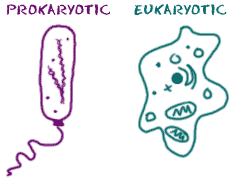 In most organisms, you will find DNA in the nucleus. Chromosomes work with other nucleic acids in the cell to build proteins and help in cell replication. You will most likely find mRNA (messenger-ribonucleic acid) in the nucleus with the DNA. tRNA (transfer ribonucleic acid) is found outside of the nucleus, floating in the cell. In a few organisms called prokaryotes, there is no defined nucleus and the DNA is found throughout the cell.
Your DNA Instruction Manual
Just remember that DNA is the instruction manual for an organism. Even though all organisms use the same five nucleic acid to build and replicate DNA, it is the order that makes us who we are. You've got the three pyrimidine bases — cytosine, thymine, and uracil — and the two purine bases — adenine and guanine. Every organism on Earth has a different number and order of base pairs. A base pair is created when one purine base bonds to a pyrimidine base. The order of base pairs determines your physiology. When you get a group of three base pairs of DNA, they can code for one amino acid. Once the string of mRNA leaves the nucleus with the information, long chains of amino acids can be constructed. That's when you have made proteins that can do work for the cell. It all goes back to the number and order of base pairs in the original DNA strand.
► NEXT PAGE ON BIOCHEMISTRY
► NEXT STOP ON SITE TOUR
► BIOCHEMISTRY QUIZ
► RETURN TO TOP OF PAGE
► Or search the sites...
► NEXT STOP ON SITE TOUR
► BIOCHEMISTRY QUIZ
► RETURN TO TOP OF PAGE
► Or search the sites...
Related Video...
Chalk Talk: DNA (US-NSF Video)
- Overview
- Metabolism
- Cycles
- Carbohydrates
- Lipids
- Nucleic Acids
- DNA
- Amino Acids
- 20 Amino Acids
- Proteins
- Enzymes
- Enz. Regulation
- Organic Chem
- Enviro-Chem

 See the full list of chemistry topics at the site map!
©copyright 1997-2018 Andrew Rader Studios, All rights reserved.
Current Page: Chem4Kids.com | Biochemistry | DNA
** Andrew Rader Studios does not monitor or review the content available at external web sites. They are paid advertisements and neither partners nor recommended web sites. Also, we do not collect or ask for personally identifiable information on any of our sites. Privacy Policy/Terms & Conditions