


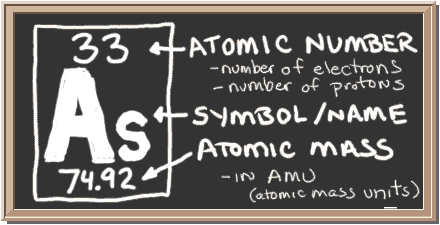
Check out the blackboard. That box on the left has all of the information you need to know about one element. It tells you the mass of one atom, how many pieces are inside, and where it should be placed on the periodic table.
Now we're working with the fourth period/row in the table of elements. You may have an easy way to know the number of electrons in a neutral atom, but the placement of those electrons gets a little more complex. Let's take a look at the arrangements of electrons in the basic elements (left and right sides of the table) of period four and the more complex arrangements of the transition elements (in the middle of the row). If you think this is a little over your head, go back and look at the elements 1-18 that have organizations that are a little more simple.
Electrons In The Shells
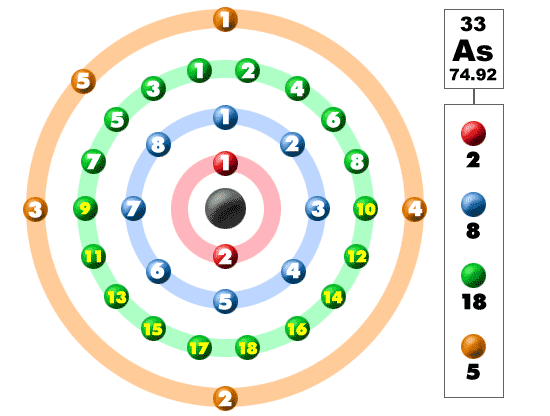
Take a look at the picture below. Each of those colored balls is an electron. In an atom, the electrons spin around the center, also called the nucleus. The electrons like to be in separate shells/orbitals. As you learn more about atomic structure, you will learn that the electrons don't stay in defined areas around the nucleus. They are found in clouds that can have different shapes that include spheres and dumbbell-like shapes. So remember when you look at our breakdown that the electrons aren't always in a nice neat order as shown here.Arsenic is found in the fourth period of the table of elements. It is a member of the phosphorus family with other elements including phosphorus (duh), antimony (Sb), and bismuth (Bi). All of the members of this family have five electrons in their outer orbital.
We keep mentioning that arsenic is a poison. It is a special poison because it accumulates over time and can never be removed by the organism. So, if you only were exposed to a small amount of arsenic and you survived, it wouldn't matter. That small amount would stay in your body forever. If you encountered another small amount 30 years later, it could all add up to enough arsenic to kill you. That's why this element is so dangerous.

 See the full list of chemistry topics at the site map!
©copyright 1997-2017 Andrew Rader Studios, All rights reserved.
Current Page: Chem4Kids.com | Elements | Arsenic | Orbital Info
** Andrew Rader Studios does not monitor or review the content available at external web sites. They are paid advertisements and neither partners nor recommended web sites. Also, we do not collect or ask for personally identifiable information on any of our sites. Privacy Policy/Terms & Conditions