


Bose-Einstein Basics
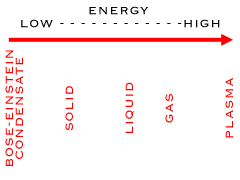 The Bose-Einstein state of matter was the only one created while your parents were alive. In 1995, two scientists, Cornell and Weiman, finally created the condensate. When you hear the word condensate, think about condensation and the way gas molecules come together and condense and to a liquid. The molecules get denser or packed closer together.
Two other scientists, Satyendra Bose and Albert Einstein, had predicted it in the 1920s, but they didn't have the equipment and facilities to make it happen at that time. Now we do. If plasmas are super hot and super excited atoms, the atoms in a Bose-Einstein condensate (BEC) are total opposites. They are super unexcited and super cold atoms.
About Condensation
Let's explain condensation first. Condensation happens when several gas molecules come together and form a liquid. It all happens because of a loss of energy. Gases are really excited atoms. When they lose energy, they slow down and begin to collect. They can collect into one drop. Water (H2O) vapor in the form of steam condenses on the lid of your pot when you boil water. It cools on the metal and becomes a liquid again. You would then have a condensate.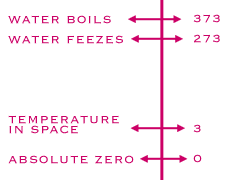 The BEC happens at super low temperatures. We have talked about temperature scales and Kelvin. At zero Kelvin (absolute zero) all molecular motion stops. Scientists have figured out a way to get a temperature only a few billionths of a degree above absolute zero. When temperatures get that low, you can create a BEC with a few special elements. Cornell and Weiman did it with rubidium (Rb).
Let the Clumping Begin
So, it's cold. A cold ice cube is still a solid. When you get to a temperature near absolute zero, something special happens. Atoms begin to clump. The whole process happens at temperatures within a few billionths of a degree, so you won't see this at home. When the temperature becomes that low, the atomic parts can't move at all. They lose almost all of their energy.Since there is no more energy to transfer (as in solids or liquids), all of the atoms have exactly the same levels, like twins. The result of this clumping is the BEC. The group of rubidium atoms sits in the same place, creating a "super atom." There are no longer thousands of separate atoms. They all take on the same qualities and, for our purposes, become one blob.
► NEXT PAGE ON MATTER
► NEXT STOP ON SITE TOUR
► STATES OF MATTER QUIZ
► RETURN TO TOP OF PAGE
► Or search the sites...
► NEXT STOP ON SITE TOUR
► STATES OF MATTER QUIZ
► RETURN TO TOP OF PAGE
► Or search the sites...
Related Video...
The Coolest Spot in the Universe (Science@NASA Video)
- Overview
- States
- Phase Change I
- Phase Change II
- Chem-Phys
- Solids
- Liquids
- Gases
- Evaporation
- Plasmas
- BE Condensate
- Mixtures I
- Mixtures II
- Solutions I
- Solutions II
- Mixture Ex.

 See the full list of chemistry topics at the site map!
©copyright 1997-2018 Andrew Rader Studios, All rights reserved.
Current Page: Chem4Kids.com | Matter | Bose-Einstein Condensates
** Andrew Rader Studios does not monitor or review the content available at external web sites. They are paid advertisements and neither partners nor recommended web sites. Also, we do not collect or ask for personally identifiable information on any of our sites. Privacy Policy/Terms & Conditions